

Rick Steves Calls One Of His Favorite European Cities 'Italy's Best Medieval Experience'
Italy is full of eye-catching medieval towns. From the picturesque yet little-known town of Pontremoli to the stunning glory of famous spots like Florence and Padua, Italy's rich history is etched into its towns, villages, and cities. Enjoying a medieval experience in Italy is a dream, whether it's exploring the iconic olive groves and villages of Isola del Giglio or discovering an unusual and eccentric corner of Scottish culture in an under-the-radar corner of Tuscany.
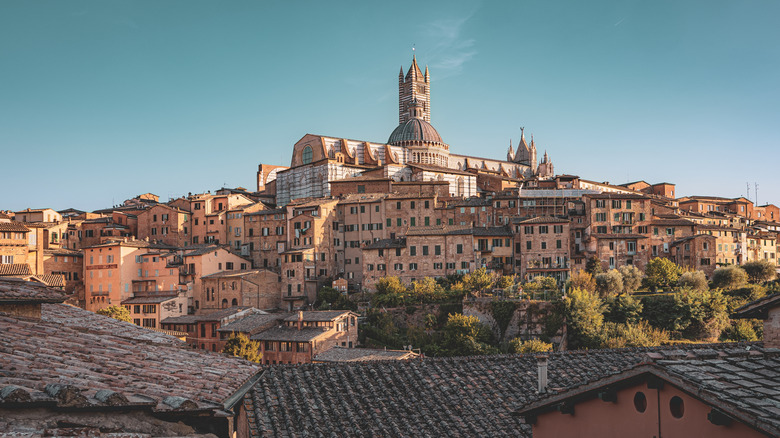
European travel guru Rick Steves is no stranger to Italy's ancient gems, and according to him on his blog, "Siena offers perhaps Italy's best medieval experience." This remarkable spot, "stretched across a Tuscan hill," is "an architectural time warp, where pedestrians rule and the present feels like the past."
Siena is located in Tuscany, in central Italy, about 45 miles from Florence. The closest international airport is Amerigo Vespucci International Airport, just 50 miles away, about an hour's drive by car. Siena train station is the terminus of the lines to Empoli, to Chiusi, and to Grosseto via Monte Antico, but it isn't on the main line to Florence or Rome, so visitors without a car are often better served by local buses.
A stunning blend of Gothic and Romanesque architecture

Siena was one of the most important cities in Italy during the medieval period, and its remarkable history is obvious, showcased in its soaring Gothic and Romanesque architecture, colorful contrade (districts), and stunning secular and religious buildings. Rick Steves discusses on his blog how the city was "in a class with Florence, Venice, and Genoa" in the 1300s, but after the plague and foreign conquest, it became a backwater and has remained under the radar ever since. However, he states that "Siena's loss became the traveler's gain as its political and economic irrelevance preserved its Gothic identity."
Steves raves about its "stony skyline and rustic brick lanes tumbling every which way" as well as its "red-tiled rooftop panoramas," and describes it as "a city made for strolling". This is certainly the best way to get the most out of the UNESCO World Heritage-listed city center, wandering the cobbled streets, dipping in and out of galleries and churches. At the heart of Siena lies Il Campo, where many of its most iconic buildings are situated. Rick Steves describes it as a "great shell-shaped piazza, featuring a sloped red-brick floor fanning out from the City Hall tower, is designed for people, offering the perfect invitation to loiter."
Dominating the square, the Duomo is unmissable, "as ornate as Gothic gets" according to Steves. Its facade and interior are a collaboration between some of the leading lights of the Italian Renaissance, including Giovanni and Nicolo Pisano, Pinturicchio, Michelangelo, Donatello, and Bernini. The Museo Civico showcases some of the best artists from the Sienese school, while the Complesso Museale di Santa Maria della Scala is filled with gorgeous frescoes. The stunning interior of the Libreria Piccolomini has to be seen to be believed, while the Palazzo Chigi Saracini is a Gothic masterpiece filled with incredible stories.
Wild horses and amazing food

Siena's center feels frozen in time, almost like an open-air museum, and its stunning medieval sights are without a doubt its main attraction. However, the city is perhaps most famous for the Palio, the "wild bareback horse race that turns Il Campo into a thrilling and people-packed racetrack" twice each summer, per Rick Steves' blog. First held in 1482, this unique occasion pits representatives from 10 of the city's 17 contrade against each other for the prize of a banner of painted silk.
While the Palio is Siena's most famous cultural offering, there's no denying that this is a city that knows how to eat well, and its cuisine is superb and well worth exploring in depth. Rick Steves mentions gourmet pasta, vintage Chianti, and boar prosciutto as delicacies he enjoys while in town, but says that "panforte is Siena's claim to caloric fame ... [a] rich, chewy concoction of nuts, honey, and candied fruits [that] impresses even fruitcake haters. According to Steves, "local bakeries claim their recipe dates back to the 13th century," and it is worth heading to Nanninni or the Antica Drogheria Manganelli to get a taste of this mouthwatering cake.
Finally, no visit to Siena would be complete without experiencing the passeggiata, the traditional evening stroll after a fortifying aperitivo that Italians love. Wandering the ancient streets as night falls feels particularly magical, and seems to open up a conduit to the past that gives this delightful medieval town even more atmosphere and ambiance.